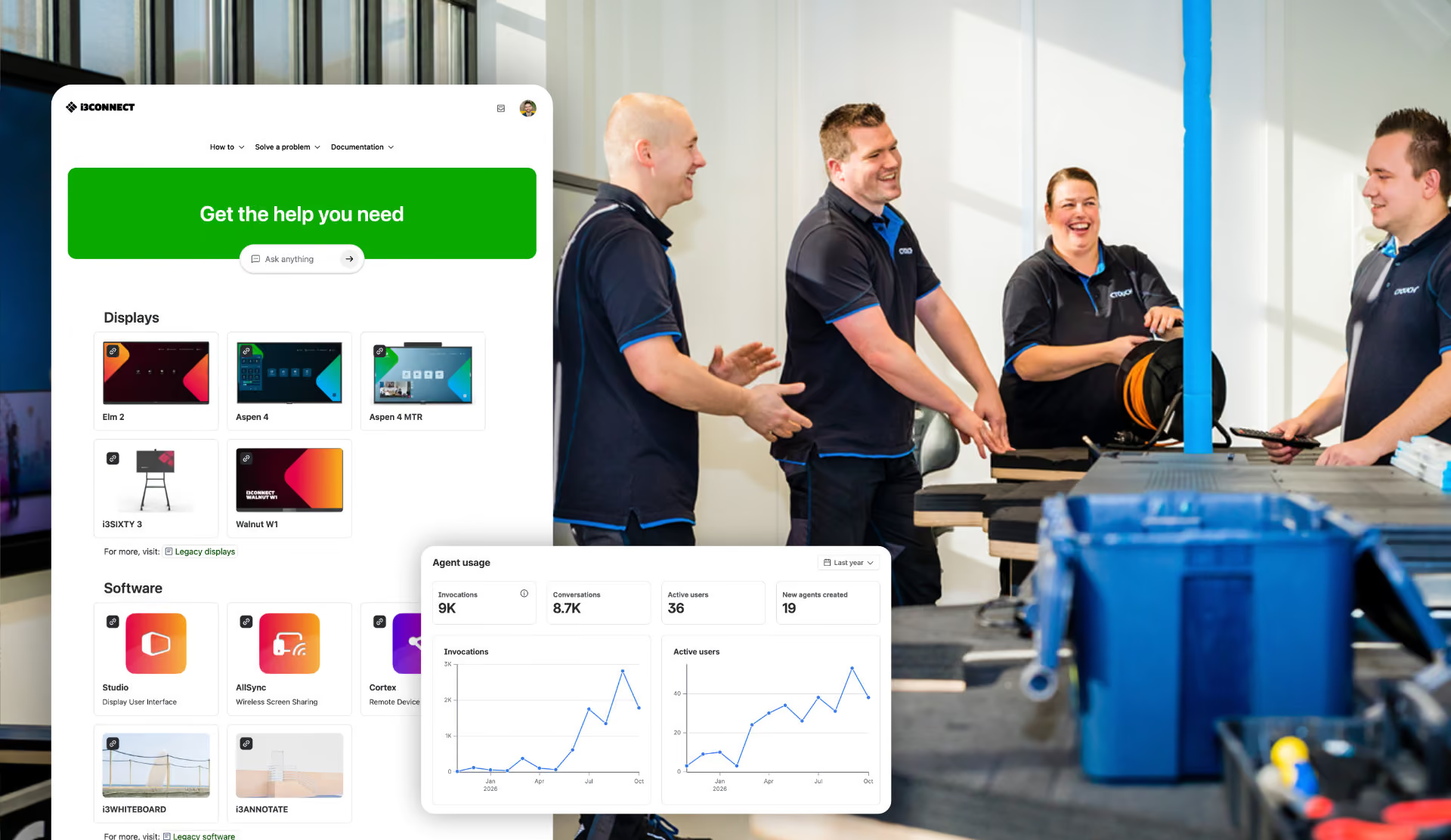
AI-enabled Support

Answers without an account

The support team of i3CONNECT had to handle the issues of two companies, shortly after a merger, with only 3 people. With no space to hire extra team members, I went looking for the cause for the workload, and rebuilt their process around self-service.

Client
i3CONNECT
My role
Service design, knowledge architecture, AI agent, portal rebuild
Years
2025 to 2026
Output
A public portal, one knowledge base, forty designed flows, and Nora AI
01 · Challenge

Nothing could be prioritised

Support at i3CONNECT could be requested when standard fixes were providing no results. The remaining tickets were the difficult questions. Often this meant that you drove to the customer and made a repair onsite.
The support team also reset demo displays, dismantle displays properly for sustainable end-of-life, and test bugs on a big list of display types. Almost all of these tasks require 2 people, simple because of the size and weight, and at least one person needed to answer tickets / calls while writing support documentation.
With 3 people, for a now doubled amount of displays after a merger, this was an impossible task. Everything was high priority. Everything was overdue.
02 · Diagnosis

Support needed more space

After diving into best practises for service teams, I found that customers often prefer self-service. It solves their problem that day, without needing to talk to someone they don't know. At i3CONNECT however, the portal(s) required you to make an account to access the knowledge base(s).
To make matters worse, the merger resulted in 3 seperate support portals, one for each company, and 5 seperate knowledge bases. The support team was expected to manage all of this next to their other tasks.
Support needed more space. So I set out to spread the workload; to our product team for writing support articles, and to our customers to self-service their issues through openly available articles and an AI support agent called Nora.
03 · Knowledge Base

Written to be found

Self-service works best when people can find answers easily, and when they can’t, when an answer can be put together for them. That second part needs an AI agent that pulls together knowledge to answers a question.
For that to work, the agent needs enough quality content, written in a way that an AI can use it. That meant going through every article from the company’s 60 years of history, many of them written in shorthand by people who didn’t have time. It also meant checking access rights carefully as we moved the content to a public portal.
I did the first review myself to get an overview. I turned that into a list of everything that needed improving after my first purge, then handed it out as tasks to the product owners to start filling in.
03 · The range

Every room behaving the same

Part of this first review was looking for ways AI agents lower the workload for support and the product team. Inside Jira Service Management, I built three agents, one for each group that uses the knowledge base.

Nora, for customers

Named after the journalist Nora Ephron. Nora answers customers concisely, and includes a link to an article if it can find it. That way customers read guides written/checked by our team. She speaks in the brand's tone of voice, knows every display sold, & follows 40 routines for common situations. When a customer wants to talk to a person, she passes them to the service team.

Albert, for the support team

Named after Albert Einstein. Albert makes use of previously answered tickets, repair guides from our repair centres, as well as the knowledge base articles to generate a short recommendation, with links. The support team can then pass this on to the customer in their own words.

Carl, for the writers

Named after Carl Sagan. Carl reviews articles written by the product team and returns an improved version in our tone of voice. It also writes content to support AI agents and Search Engines to find content faster. Customers still get the same quality answers using their own tools of preference. Carl also checks for content needing review, and duplicates to remove.

Specification
Detail
What it delivered

Knowledge

Three for customers and two internal, merged into one space with the redundancy taken out.
One source of truth

Accessibility

The portal front end rebuilt without a login, because customers told me in interviews that they would not sign up for one.
Self-service is possible

Intelligence

Around forty scenario's as well as detailed agent characteristics ensure that Nora runs provides the best possible support before needing the support team.
Fewer tickets to a person